Current Weekly Notices

  • Reports and portfolios go home on Friday and each child will find out their class and teacher for 2014.
  • Middle School picnic Friday 13th December at school. Please bring togs and water pistols if children desire and something for room 6s shared lunch.
  • Tuesday 10th BOT - Board of Trustees meeting.
  • 11am Monday Special Assembly for official raffle draw.
  • Please keep the McIntyre family in your prayers with the sudden passing of our McIntyre children's grandfather.
  • Children are to have a hat and wear it outside at ll times at school during terms 4 and 1 - please encourage children to comply.
  • Please continue to encourage children to self manage and bring their home reading back on a Friday - handing out is on Monday.
  • Please make sure all items of children's clothing, including hats and shoes are clearly labelled with the child's name so items can be easily returned. Encourage your child to take reponsibility for finding and bringing home their uniform and lunchbox themselves. Praise self-management.
  • Mr. Bach's email - david@stmarys.rotorua.school.nz....
  • Room 6 swim even numbered weeks.
Showing posts with label Aluck. Show all posts

Saturday, 2 November 2013

Picture Prompts - writing

 Picture Prompts - Motivating to Write and stimulating thinking

A good way of getting children to write is by using picture (usually photo) prompts. Big pictures are best and they can be electronic or in paper form, as long as the children are able to look at them closely from the place from where they are writing.

Children can be guided to describe the setting or a character in the setting by using looks like, feels like, smells like and sounds like, or they can use the scene to begin a story using who, what where and when.


 The children may have to be encouraged to choose a prompt as procrastination in making a choice is common.
 Room 6 children have chosen their prompts in this picture and are now orgainising their books and other writing equipment.
Some children are very happy and motivated writers - others may need support and encouragement to write.

Sunday, 7 July 2013

Children's author - Terri Rose Baynton

 Children's author - Terri Rose Baynton

A couple of weeks ago Room 6 children were lucky enough to go to the hall to see visiting children's author Terri Rose Baynton. She talked to us a little about how she became an author and about the latest book she has just had published. Terri then gave an interesting lesson on how to get ideas for your story writing and drew some very funny illustrations on the whiteboard. Thank you Terri.


Sunday, 16 June 2013

Carbon Footprints

 How big is your footprint?

Room 6 have been learning about carbon footprints and how many of our practices in the West cannot be sustained. We must reduce the amount of carbon dioxide (CO2) and methane we are producing through our daily activities and choices.


We looked at the ways we are all contributing to raising levels of greenhouse gases on Earth, which are helping to heat the planet. We asked, 'how big is your footprint?


We then discussed all the different ways and all the different things each of us can do to reduce our carbon footprints.
The children traced their own footprint and wrote all the ways they could help reduce their own carbon footprint onto their foot poster.


 The children used some of the class' ideas and some of the children came up with their own individual ideas.


Sunday, 14 April 2013

Communities - Term One Concept


 Communities Concept

The Term One Concept at St Mary's School in 2013 is Communities. The children looked at different types and sizes of human communities and how they function. The children also looked at the roles and responsibilities of everyone living in various communities. They learned that the word  'interdependence' means everybody relies on everybody else in any community.

The children then learned about ant communities and how they work and compared them to bee communities.

The children completed a compare and contrast map to plan their writing assessment and then wrote about the similarities and differences between ant and bee communities.

Some children are also preparing information boards using the Comic Life app on the i-Pads.
 The children helped research information about bee and ant communities and this information was displayed in posters.


 One interesting thing that we learned is that ants are very strong for their size. They can lift up to ten times their own weight. That is like Mr Bach lifting ten adults above his head. Actually he can only lift nine!!!!!!?

 Ants can farm aphids for the honeydew (liquid food) that oozes out of the aphids backs. In return the ants protect the aphids from predators, including fighting off larger ladybirds.The aphids are free to drink sap from the plant to eat themselves and provide more honeydew for hungry ants. The ants and aphids rely on each other.


 Bees are also interesting insects that live in large communities like ants. Unlike ants, all bees fly and when a worker bee finds a special pollen or nectar source she performs a dance to tell other bees. The type of dance tells the other bees in what direction and how far away to fly to find the pollen.


We also learned that the Maori for communities is He Hapori and that the various levels in the Maori community are very important to the health and the flow of life in the Maori world.

Tuesday, 2 April 2013

Maths in Room 6


Maths in Room 6

Maths in Room 6 is done for usually one hour every day, bright and early in the morning during the first block, before morning tea.
In Room 6 have a rotation system in place where children are grouped according to their current needs and abilities and then go through a range of activities and exercises during the one hour of maths. These exercises and activities are to support the teaching and learning of maths knowledge and number strategies by Mr Bach.

The first stage of the rotation is learning on the mat with Mr. Bach where we practice our basic facts a little and then learn a new number strategy, or talk about one we are still learning. 

At present we are learning strategies to help us with addition and subtraction.

We use materials and the interactive whiteboard to help us learn.
 Children will then work independently in the next stage of the rotation to practise the strategy that they are learning by doing book work. Worksheets will often have the strategy explained on them, and when we are lucky Miss James is often around to assist. 
 Children in the same group will often help each other with their learning, especially when the strategy seems hard to understand the first time.
 Another stage in the rotations is practising basic facts on the computers through particular websites, especially Tutpup and Studyladder. Studyladder can also help children with their strategies.
i-Pads are also used to practice basic facts.
 Veronica concentrates hard on her book work.

 Lucille tries to practise the new strategy that she has just learned.
 Malia and her classmate use play money to help them with their maths learning.


 Naina and Veronica are practising adding strategies that use tidy tens or splitting numbers by using place value (the chainsaw strategy).

Ria shows clearly how she has used one strategy to work out the addition problems.


This term we have also been learning about statistics and how the basic statistical investigation works. Find a problem - Do a survey - Record your answers in a tally chart - Put your data into a graph - Talk about what information the graph is telling us.
Children are at various stages in being able to follow this process.

Sunday, 17 March 2013

 Life Education

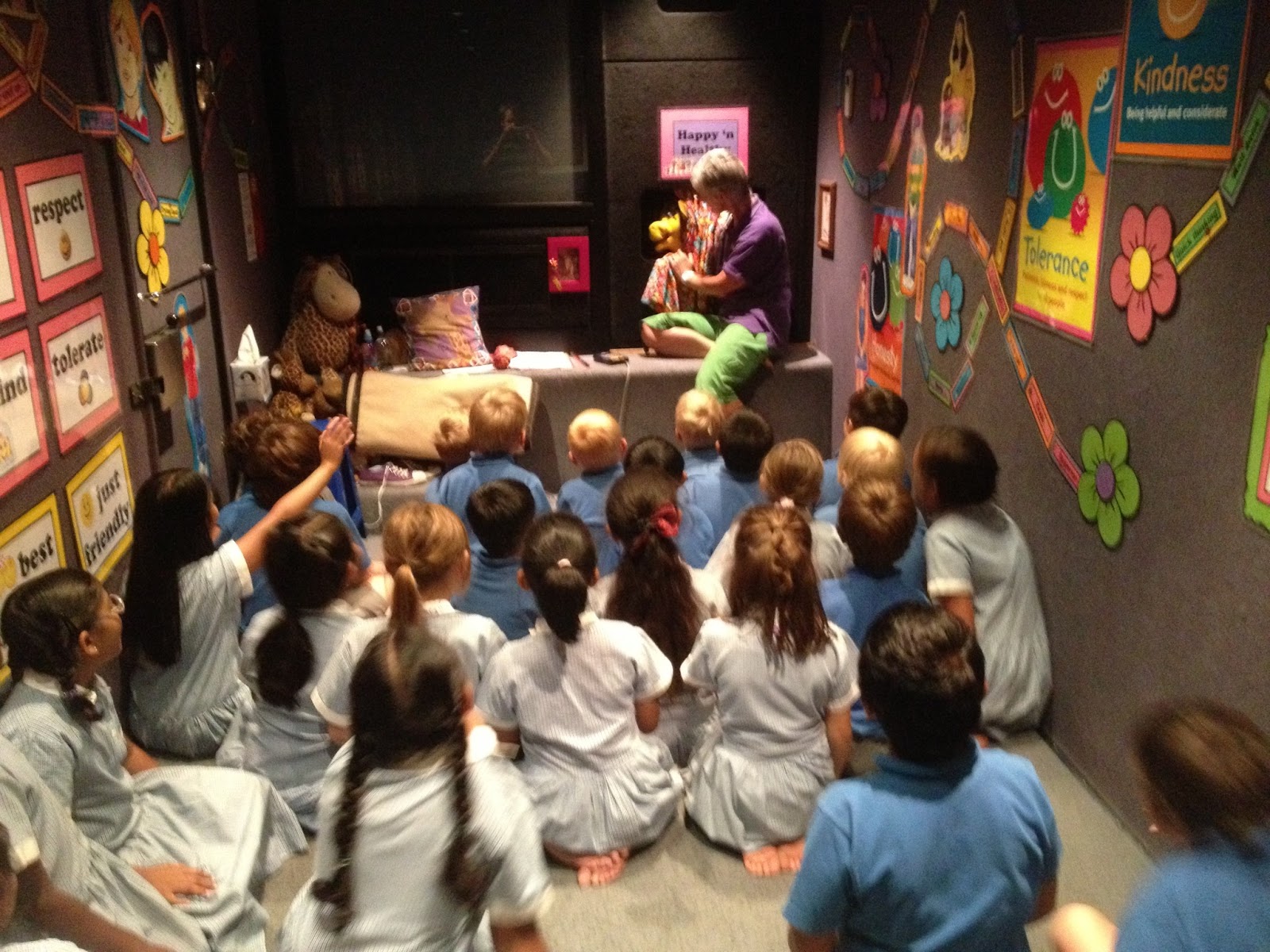
On Friday last week room 6 were lucky enough to have a second learning session with Bernie and Harold the Giraffe in the Life Education truck.
Children learned about the functions and locations of some of the organs in the human body and got to play doctors for the day. Bernie also talked to us about how to treat others around us and how to avoid and protect ourselves against bullying behaviour.
 The children had great fun identifying the organs in the human body and placing them on 'Suzie' in the right place and position. Everyone was keen to be chosen to play doctor. Only those on their absolute best behaviour got chosen, although as usual some children did miss out.

 Doctor Naina and Doctor Tyler try to work out what an organ is and where it goes on Suzie. If the doctors couldn't work it out then they asked the audience to put their hands up to answer.


Angelina is keen to be chosen as a doctor.
 Harold came out to talk to us at the end and to remind us of all the learning we had been doing. Harold tried to convince Bernie he had been behaving and not watching too much 'Sponge Bob Squarepants. Bernie wasn't too sure if she could believe him.


The children creep forward to get a better look at Harold.
 Bernie and Harold are amazed by all the stars on the ceiling of the truck.


Willem is lucky enough to get up close to Harold and meet him. He pats Harold and gives him a hug. Because they have been so well behaved during learning at Life Education, Harold agrees that everyone can come and greet him personally and give him a pat or a hug.


Saturday, 9 February 2013

Letter of Introduction from Mr. Bach Classroom Teacher


Dear Parents and Caregivers,

   This letter is to introduce myself as your child’s teacher and to outline the expectations I have about learning and behaviour in room 6 in 2013. 

Learning and Behaviour

   Children should all understand by now that the main reason for them being at school is to Learn and that the best way to become better Learners is for them to become better self managers. I will be continually encouraging children to manage their own behaviour and learning, and to take increasing responsibility for their own lives. Please assist me by encouraging your child to take responsibility for themselves, in every area of their lives, as much as possible. Poor self management will lead to ineffective learning and can disrupt teaching.

Teacher Contact Details

Please note that we have a class blog up and running this year and that I will be using the blog for all communications with parents about news, events, homework and anything else that may be going on around the school. The Blog address is: http://room6stmarysrotorua2013.blogspot.co.nz/
You may contact me by email at any time. I check my mail at least twice daily Sunday to Friday. My address is david@stmarys.rotorua.school.nz
I am also happy for you to contact me by cellphone, or at home, for urgent matters, at any time. Please come and ask if you would like my cellphone number.
If you have any other questions about room 6 in 2013, or if you have any issues or problems you wish to discuss, please contact me sooner rather than later. I have an open door policy, but please be aware that some days can be very busy. The mornings are not a good time, unless it is brief, or in an emergency. After school, later in the week, is the best time for me to meet parents.
Please make sure you sign up for the beginning of year teacher interviews next week. Go to www.schoolinterviews.co.nz , enter the event code that was in the newletter, and follow the steps to book a 10 minute interview time to discuss your child’s learning for the year.

Homework
  
   Homework is a delicate subject that arouses a variety of opinions among parents and I wish to make my philosophy clear from the beginning. The most important homework for young children is personal reading and this will be my main homework focus for the year and the only absolutely compulsory homework. It is often apparent, at the beginning of the year that some children are not reading anywhere near enough on a day-to-day basis, outside of school. When possible children should be reading for a minimum of 20- 30 minutes a day, outside of school, (usually in the evening) including holidays and attempting to read a range of materials at their level e.g. fiction books, non-fiction (fact) books, children’s magazines, and appropriate online materials aimed at children. Putting in the reading mileage (reading a lot, often) helps learning in all areas.  Many independent learners even at 7-9 years old are reading for several hours a day. Please note it is free for Rotorua residents to join the Rotorua Public Library and children’s books are free to take out. Children may also borrow books from St Mary’s School Library and my own personal class library.
Reluctant readers can be hard to motivate at home. One technique that I found worked well with my own son at 7-12 years old was to model reading behaviour by reading my own book or newspaper on the bed next to him as he read (and ready to answer questions). Of course some of the younger members of the class will need direct assistance in reading their books to you. Some children, who need extra help will go onto the Home Reading Program and will receive books to take home on a Monday, to be returned on Friday. Children under the standard will also receive one-on-one tutoring in reading to try and give them an extra boost to catch up. Books are not systematically sent home with all children at the Middle School Level.
   If possible I would like to see children spend about 5 minutes a night on memorizing their basic facts, including times table facts for the more able mathematicians, for instant recall. This is mainly a memory exercise for gaining factual knowledge, rather than a purely maths one, and will greatly assist classroom teaching of increasingly complex math’s strategies. It is a simple fact that many children need someone to help and motivate them.  Repetition out loud is one way to reinforce the basic fact to memory, especially if it part of a competition or game. Online math’s games such as tut-pup can also be a fun way to learn basic facts and I am encouraging children to sign-up to tut-pup so they can practice basic facts at school and home, by competing against other children online. Please remind your child that they need to choose a level or a times table that is challenging, not one that they can already do. Many children in the class will understand the math’s concept that 3 x 5 is 3 groups of 5 and can work out that the total is 15 (especially if given equipment, or by using skip counting), very few know 3x5=15 as an instantly recalled fact.
   Children will also usually receive a written or research task for homework for the week, or they may be referred to a link on the class blog. The task may be linked to our school term Concept. This term our concept is Communities. I am also encouraging the children to use the class blog and to look at the posts and links at home, as well as at school. Homework can be done in the homework book or on a computer.  In 2013, for spelling, we will be running our Smartwords program again, but essential word lists are available on request for those parents who like using these lists. Some families are very busy and some children are very tired by late afternoon, so it is up to parents to judge how much a child is capable of doing each day and week. Again, please note that the 20-30 minutes reading a day is the only ‘must do’ homework on ‘most’ nights. If a child is too tired or angry forcing them to read is not advised, leave it until tomorrow. If a child persistently refuses to read please come and see me. I will post the homework on the Class blog each week. Please ask for a paper copy to be sent home if you require one.
     
Middle School Teaching Program

The children will be writing about personal experiences this term and learning about explanation writing, which will be linked to our concept of Communities. In RE we will be doing the Jesus Strand as well as looking at Lent. In reading I will be looking at introducing the children to a wide range of comprehension strategies. The children are currently being grouped for maths and will receive teaching, at their stage, on place value and addition and subtraction strategies. We are looking at the Statistics Strand in maths, which is highly relevant with the National Census coming up soon. Here’s hoping for a productive year of learning in room 6 in 2013.


Yours Sincerely
David Bach
Classroom Teacher